Rafiki Tapir Project
(RTP)

Baird's Tapir Species Information

Project Proposal

Current Research

Frequently Asked Questions

Recent Tapir Activity

Links and References


Rafiki Safari Lodge is part of a sustainable project focused to re-introduce the Baird's Tapir back into the wilderness of the central pacific coast of Costa Rica. The project includes the lodge and tent camp, a 2-3 acre “intensive” acclimatization enclosure, (where newly introduced tapirs will be monitored when they arrive from captivity), a 60 acre “extensive” breeding and acclimatisation enclosure teamed with a 750 acre wildlife refuge. Rafiki is connected to vast wilderness areas including La Reserva Los Santos, Chirripo National Park, and La Amistad National Park through a corridor known as "Las Altas de la Pantera". It is the strategic location of Rafiki along protected tapir migration routes that creates this opportunity to help save these remarkable, docile creatures.

Related to the horse and the rhinoceros, tapirs are the largest land mammals in Central America, weighing up to 300kg. They were hunted throughout the 1900's for their meat, their thick hides and for sport, almost to the point of extinction. Although they are now protected, their numbers have been slow to increase and they are still endangered. Through our reintroduction project, we hope to increase the genetic diversity within the small populations which exist in the surrounding wilderness areas as well as increase the over all numbers, and so improve the chances of the survival of the species.

Rafiki is utilizing a cyclic sustainability philosophy. The basic idea is to generate funds using sustainable tourism in order to re-introduce wild species back into the forests of Costa Rica. The newly introduced animals attract people, and so the cycle begins. In this manner it is possible not only to save animals but due to the increase of land value due to the wildlife within them, it is possible to save entire forests, and reclaim lands that have fallen to agriculture, and save them from the hands of developers.

This model has been seen to function in South Africa, where thousands of hectares of farm land has been left to grow wild so that the native animals can once again take over. The model only succeeds if there is enough interest and of course capital generated by the land to justify its action. Commercial hunting had an enormous impact in South Africa. Here in Costa Rica the model is similar but the hunting is not necessary: most people who visit the country are naturally attracted to the unspoiled beauty of the forests and National Parks and rich and diverse flora and fauna found within these fascinating natural ecosystems.

With this project at Rafiki we hope to create a model for genuine sustainable tourism, which can be recreated not just in other parts of Costa Rica but all over Central and South America.

So far we have done much of the research and groundwork to make this dream a reality, with the help of a team of local and international biologists and veterinarians.  The lodge has been up and running since 2002 and work is ongoing to continue with the next phase of the project to allow us to construct the enclosures and eventually bring the first tapirs here for reintroduction.  pollyunderdown@gmail.com


More info about the Baird’s Tapir…

The tapir is not a well-recognized animal like the rhino or the giant panda – many people don’t really know what one looks like and most people have never seen one, even in a zoo.   And so here is a little bit of information about the animal we are planning to reintroduce.

Order:  Perissodactyla
Family:  Tapiridae
Species:  Tapirus bairdii
Spanish name: Danta

Range: Southern Mexico to Ecuador, from sea level to over 3000m


Size: 2m, 250kg, (80 inches, 550lbs), males slightly smaller than females, the largest native land mammal in Central and South America

Life span: up to 35 years in captivity, although probably less in the wild


Appearance and anatomy

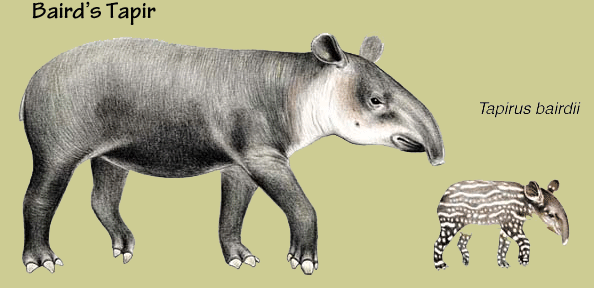
Although the tapir’s closest relatives are the horse and rhinoceros, it resembles a large pig.  Adult tapirs are blackish brown in color with white tips to their ears.  The young also have white streaks and spots on their backs, which helps to camouflage them from predators such as large cats.  However just as puppies lose their soft downy fur as they mature, tapirs lose these white marking on their backs at around 4-6 months old.

A Baird’s tapir has a very mobile and muscular upper lip, which could be likened to a large snout.  However rather than using it to root for food as pigs do, the tapir uses it more like a short trunk to reach leaves it cannot reach with its tongue and to bend and snap tasty young saplings.  It has well developed incisors, (front teeth), like a horse, as well as strong and hard-wearing premolars and molars (back teeth) which it uses to chew foliage and crush and grind some of the hard seeds which make up part of its diet.

Tapirs have 3 hoofed toes on their hind feet and 4 on their front feet, although the fourth toe is a little higher then the others and so is not always visible in tracks.  The design of their feet allows them to travel easily through muddy areas.  As they sink, the toes splay and then as the feet are withdrawn from the mud the toes are brought together and the narrower foot is easily and silently extracted. 


Diet

Studies have shown that around 75% of a tapir’s diet consists of stems and leaves and the remainder of fruit of which they seem to be particularly fond if given the choice.  This probably varies seasonally.  They are known to eat over 100 different plant species, many of which are found growing naturally in this area.

Habitat


Tapirs are mainly found in remote regions, probably due to hunting, often in areas of secondary forest, which may provide them with the widest variety of food.  Fresh water is an essential part of their habitat.  They usually rest in or near water and also seem to require water to defecate. 

Breeding


The gestation period of a tapir is 13 months.  Females usually have a single calf, which will stay with her for up to one year after birth.  They tend to have young every other year.  The young reach full size and sexual maturity by 2 or 3 years of age.   They are therefore very slow to reproduce and numbers have been slow to increase, even in areas where they are protected form hunting.


Behavior

Tapirs are generally solitary animals and are active by day and night, although studies have shown that their peak activity is shortly before dawn and shortly after dusk.  Because of this it is thought that they have fairly good night vision.  They are wary of humans, wisely so perhaps, given the fact that they were hunted almost to extinction throughout most of the 1900s for their meat and hides and for sport.

During social interactions they make clicking hiccupping sounds, or descending whistling calls to more distant tapirs.  When irritated they pin their ears back and flare their lips like horses and when nervous they hold their ears upright and still, suggesting that they have a fairly well developed sense of hearing.

The sense they seem to rely on most, however, is their sense of smell.  They sniff the air constantly when nervous are rarely seen for long from downwind.  Tapirs tend to sniff food carefully before eating, rejecting what they don’t fancy.  They also use scent to mark where they have been, by digging the ground with their hind feet and urinating.  In their favorite spots, accumulations of white urine crystals may be found.  

Tapirs are surprisingly agile creatures and can run as fast as a man.  When fleeing they can charge through dense undergrowth, protected by their thick skin and aided by their tapered shape.  They are also good swimmers and are able to ascend almost vertical slopes.


Bibliography

The Natural History of Costa Rican Mammals, Mark Wainwright
Field Guide to the Wildlife of Costa Rica, Carol L. Henderson
Costa Rican Natural History, Edited by Daniel H. Janzen


More info about Rafiki’s tapir project…


My name is Polly Underdown and I am a veterinarian, originally from Scotland, and I have been working on the tapir project at Rafiki since April 2007.  pollyunderdown@gmail.com

One of the first things that many of our guests ask me is ‘when are you going to bring in the tapirs?’  It is a valid question – 5 years seems like a long time and still the fence for the enclosures are in the planning phase.  The truth is, it is a long process.  And so below I will explain some of the work I have been doing and what still requires to be done to before we can finally reintroduce our first tapir.


Project Proposal


In the past few months I have been working on our project proposal, a document that outlines the main aims of our project, and circulating it amongst international tapir specialists, (researchers, veterinarians and biologists).  I have received a great deal of support and advice from many parties which has helped me tremendously in deciding all sorts of things such as the appropriate type of fencing to use and investigating possible disease risks. 


‘Hands-on’ Experience with tapirs

I have also made trips to Summit Zoo in Panama City to help with the treatment of one of the male tapirs there, to San Diego Zoo and the Wild Animal Park and to Chester Zoo in the UK to discuss our project with veterinarians and keepers there.


The Fence
The design and location of the fence is crucial to the success of the project.  Tapirs are in fact far more agile than they appear and they are good climbers.  They can climb almost vertical slopes and easily scale a 3ft fence and so the recommendation is for it to be 2m tall, with no horizontal bars.  I have looked into the possibility of using an African-style game fence but in the end chain-link looks like the best option from the research I have done so far.

 Another potential problem with a fence in the forest is tree-fall, a frequent and natural occurrence.  There is no way that we can avoid this without clearing the trees either side of it, (which is illegal and also completely against Rafiki’s ethos), and so Jose Luis, one of the local workers who has worked at Rafiki since 1999 and whose father farmed the land before that, will walk the perimeter twice daily and carry out fence maintenance as well as harvest additional food from the forest for the tapirs in the intensive enclosure.


The TSG Reintroduction Protocols

Currently we are eagerly awaiting the publication of tapir reintroduction and translocation protocols by the Tapir Specialist Group (TSG).  The TSG is a member of the Species Survival Commission (SSC), which is a branch of the International Union for the Conservation of Nature and Natural Resources (IUCN).  The protocols are recommendations and suggestions that are being drawn up by the TSG to increase the chance of successful reintroductions and translocations.  From these protocols and with good record-keeping, the conservation world will be able to learn from both successes and problems encountered. Until these protocols have been finalized, understandably the TSG are unable to endorse our project.  Project endorsement by the TSG is necessary before we start constructing fences for the enclosures because obviously if our ideas do not fit with their recommended protocols then we would have take them down and start from scratch.  This would be a time-consuming and costly mistake.  The protocols are due to be published in 2008. 


4th International Tapir Symposium

The 4th International Tapir Symposium organized by the TSG is 26th April-1st may 2008 in Cancun, Mexico.  There will be workshops, discussions and talks about current and future projects, as well as reports on how the Species Survival Plan (drawn up after the First symposium in 2001) is being implemented and what further steps need to be taken.  It will be a fantastic opportunity to meet many of the world’s tapir experts face to face and we are also hoping to present Rafiki’s Tapir Project at the symposium.


Current research

In the meantime I am continuing the risk assessment for the reintroduction.  Currently I am investigating the incidence of tuberculosis in the valley.  Tapirs are susceptible to TB and although any tapir would be screened for TB prior to reintroduction, it is important to find out if there is a high incidence of TB in the cattle population. If a tapir were to contract TB and then migrate and spread it to another tapir population this could have very grave consequences.  And of course it is important from a public health point of view as well.

I am also investigating current GPS tacking technology.  We hope to be able to track reintroduced tapirs with minimal disturbance by using GPS technology.  This would give us valuable information about how they are interacting and how far they are roaming.  Radio and GPS collars are being used in other tapir studies, however I am wondering if the technology exists to insert a GPS microchip.  This could be done when they first arrive and there would be no need to replace them every 5 years as is necessary with the collars.  Other potential issues with a GPS system could be that in dense undergrowth and with cloud cover whether it could be tricky to get GPS readings. 

Contact us

Below are the answers to some frequently asked questions, but if anyone has any other questions, comments or information for us then we’d love to hear from you.  (pollyunderdown@gmail.com)


Frequently Asked Questions

 When are you going to bring in the first tapir?

All is explained above!  (Specifically read the section about the TSG protocols).

Why save tapirs?


It is thought that tapirs may have been important in seed dispersal and therefore allowed the survival of many well-known plants found in Costa Rica, including gourd, guapinol, guacimo and Guanacaste trees.  (The Guanacaste tree is the national tree of Costa Rica).  Nowadays the seeds of these trees are more commonly dispersed by domestic horses, however horses are not native to Costa Rica, unlike the endangered Baird’s tapir who is known to relish the fruits of these trees and was once much more common.

In addition to their role in seed dispersal, it has been suggested that the presence of tapirs may speed the recovery of tertiary and secondary forest back into primary rainforest. As mentioned previously, they tend to selectively browse many different plant species often found in the thick under-storey of a forest.  By eating many different plant species it is likely that this will have an impact on the type of plant species that are successful in competing for light and nutrients.  It has been suggested that this may allow certain pioneer species to grow with less competition from under-storey plants.  This hypothesis has yet to be proven scientifically but we are excited that Rafiki’s project will provide many opportunities for this and other research studies which will provide us with more information about the Baird’s tapir and its impact on the environment in which it lives.

Many people do not know what a tapir looks like.  If people do not know about them, then people are unlikely to care about their existence.  Rafiki’s project to help try and save this species will not only help the tapirs but also through education it will hopefully encourage the local community here to care for the forests and all the other plant and animal species in this area

Why have tapirs become endangered?

Tapirs are now an endangered species and are legally protected however their numbers have remained low.  It is estimated that there are fewer than 1000 Baird’s tapir left in Costa Rica, and it is thought that the number is continuing to decrease.

Tapirs were hunted extensively in the 1900’s for their meat and hides as explained previously. There has also been significant habitat destruction during this time.  Although wild populations do still exist in Costa Rica, mainly in protected areas, these populations are scattered and in some cases isolated from each other, and so mixing of the genetics is less likely. 

Another major factor as to why tapirs are still endangered despite laws that have made it illegal to hunt them is their slow rate of reproduction.  The gestation period of a tapir is 13 months and the calf stays with the mother for up to a year after birth.  From the ongoing study in Corcovado National Park it has been estimated that on average a tapir will produce a single calf every 20 months.  In addition to this, they take a while to reach sexual maturity – at around 2-3 years of age.  It’s a slow process.  Like its cousin the rhino, the tapir has been shown to breed well in captivity.  By giving them a helping hand and playing a more active role by reintroducing captive-bred tapirs we believe the species is more likely to survive than if they are simply left to reproduce in the wild.


How many tapirs do you plan to reintroduce?

Tapirs tend to be fairly solitary animals.  It is thought that they may also be monogamous, (stay with one mate for their lifetime), an unusual trait for most mammals.  Research is ongoing to test this hypothesis.  Based on data collected from Baird’s tapirs at Corcovado National Park on the Osa Peninsula, Costa Rica, it has been estimated that the home range for an adult tapir is around 2.5 tapirs/km2 when home range overlaps are taken into account.  Juveniles tend to have smaller home range sizes.  Research is continuing in Corcovado to collect more data on this too.

Here at Rafiki tapirs will be introduced either singly or in breeding pairs, depending on how they have been kept in captivity.  If we were to introduce 2 tapirs unaccustomed to being together there would be a high risk of fighting and possible mortality.  The number reintroduced will depend on how quickly they adapt to their new environment and whether or they migrate to join other populations or remain in this part of the valley once they have been released from the extensive enclosure.


How can you be sure that reintroduced tapirs will not be hunted?

This is a very important point.  It is not inconceivable that poachers could come and continue to hunt them.  However within the Savegre Valley everyone I have asked about this issue has replied that they do not think it will be a problem, since everyone is aware that they are endangered, and Rafiki’s project is well known and respected locally.  Interestingly, some have also added that the meat really isn’t very tasty anyway!

The presence of biological corridors means that even if they leave Rafiki’s refuge, they will be able to migrate safely.  Generally tapirs are shy animals and wary of humans.  They do not have a reputation for damaging crops and people in the valley seem to be supportive of the project.

The recent incident when a tapir had to be rescued after falling into a tank on a nearby farm was further proof of the mentality of the people living in the Savegre Valley.  I have little doubt that if the same incident had occurred 10 years ago then the tapir would have been killed, however it was the villagers of Rio Blanco, 5km further up the valley from Rafiki, who alerted Rafiki to the problem and included us in the rescue attempt.  Everyone was there to save it, not kill it to put meat on their tables.  I believe that in the 8 years of Rafiki’s existence, the locals have learned the value of saving these creatures and this incident is proof of that.  For an account of the incident, see below (Recent Tapir Activity)


Why is TSG endorsement so important?

With TSG endorsement, our project will gain credibility with zoos, researchers and conservation groups worldwide.  This in turn will be a great asset to our project when it comes to sourcing tapirs for reintroduction and general support.  It will also mean that Rafiki can become an important platform from which research studies can be carried out, and which can be used to contribute to other ongoing research.


How will the project be funded?

Rafiki believes now that the lodge has been up and running successfully for over 5 years that once the project has been set up,
It will be possible to maintain the project from the revenue from the lodge. 

The funds neccesary to build the fence have been pledged already which was our first major hurdle.

Another major cost will be transporting the tapirs to Rafiki, however until we know where the tapirs will be coming from it is impossible for us to say how much this will be. (Until we have endorsement of our project by the TSG we are unable to say.)

We also hope to be able use some sort of GPS tracking system to allow us to monitor them while causing minimal disturbance to their natural behaviour.  Research as to the type of tracking system we hope to use is ongoing, and so as yet I am unable to do a cost analysis for this. 


References

Project Proposal: Baird’s Tapir Ecology on the Osa Peninsula of Costa Rica, Kendra Bauer
The Natural History of Costa Rican Mammals, Mark Wainwright
Field Guide to the Wildlife of Costa Rica, Carol L. Henderson
Costa Rican Natural History, Edited by Daniel H. Janzen
TSG Newsletter, June 2007

Links

www.tapirs.orgTapir Specialist Group
www.savetapirs.org
Corcovado Tapir Project


All Photography By Lautjie Boshoff
© Rafiki Safari Lodge 2007
Contact Webmaster for information regarding this site.